 smallbox
Case study
Video production pipeline for a YouTube channel
Structure & Flow is our YouTube channel: calm animated films that explain how a system works by building it up, piece by piece, in one illustrated world. The first film asks why a town that already has safe tap water also grows a second, much more elaborate system for the same drink: bottled water.
About seventeen minutes. Pressing play loads it from YouTube.
Behind the channel is a production pipeline. A person brings the subject and says yes at each step, and AI does the writing, the drawing, the animation and the voice. This page shows how it works, what it made in its first five days, and what it does not do.
What its first run made
The pipeline was set up on 2 October 2026, starting from a working prototype of the first chapter. The full film went public on 6 October. By then the pipeline had made:
- the full film, 16 minutes 57 seconds, rendered in 4K;
- eight chapter videos, each one chapter as it plays in the film, closed by the film's own ending, public one every second day from 8 to 22 October;
- four Shorts for phones, vertical and under 45 seconds, each showing one mechanism on its own, planned for after the last chapter;
- a thumbnail for every video, rendered from the film itself;
- the texts: titles, descriptions with their sources, chapter lists, and captions taken from the narration's own words.
The channel's one-page website, structureandflow.me, plays the film, and every video is on Structure & Flow's YouTube channel.
Who does what
| Who | What they do |
|---|---|
| Jack | Owns the channel. Brings the subject; approves the brief, the script, the voice, the cut and the release; passes drawing requests to Codex. |
| Claude | Directs. Writes the brief and the script, checks every claim, builds the film in code, produces the voice, reviews the result as a viewer, and sets up each video on YouTube. |
| Codex | Draws every person, building and vehicle, to a written request. |
| ElevenLabs | Makes the narrator's voice, the music and a few sound effects. |
Each keeps to its part. Codex never decides the story, and ElevenLabs never decides the words. When a picture is missing, Claude writes a request for it instead of improvising one.
How a film moves through it
Each step is cheap to change before the next one starts and expensive after it: a sentence costs nothing in the brief, a minute in the script, an hour in the animation, and a day once the picture is timed to the voice. So each question is settled before it becomes expensive.
- The brief. What the film explains, what the viewer can do afterwards, and the question each chapter answers. Jack approves it.
- The claims. Every concrete claim goes into a ledger, with its source or its reasoning, before it is drawn as fact. A clear animation can make a weak claim feel obvious, so the picture never claims more than the ledger holds.
- The script. Beat by beat: the picture, the movement, the words and the claim behind them. It is read three times before Jack sees it: for cause (does each beat follow from the one before), as a viewer (at the end of each chapter, what would they think they had learned), and for overclaiming. Then Jack approves it.
- The drawings. What the library already has is reused. What is missing becomes a written request to Codex, and each delivery is checked at the size it will have in the film, then accepted or sent back with notes.
- The rough cut. The whole film animated with a stand-in voice, then watched with the sound off. If the story cannot be followed without sound, the story is fixed before anything is polished.
- The voice. The words are locked, then the voice is generated one scene at a time, so a changed sentence costs one new take, not a new film. Jack approves the voice by ear.
- Timing and music. The picture is fitted to the voice, never the voice to the picture. Music comes last, low under the narrator.
- Review as a viewer. The real render, watched from beginning to end. Jack approves the cut.
- Delivery. The 4K masters, the chapter videos, the Shorts, the thumbnails and the texts, and a record of what was posted where, so nothing goes out twice.
What is automated, and what is not
The making is automated. Claude writes and builds, Codex draws, ElevenLabs makes the voice and the music, and the computer renders. The chapter videos, the Shorts, the thumbnails, the captions and the setting-up of each video on YouTube come out of the same process. The nine 4K masters took about two and a half hours to render, on one desktop computer.
What the film says is not automated. The subject, and what is worth making visible about it, live in the head of the person who knows the field, and getting that out is not easy. For Structure & Flow, that person is Jack. From there, the pipeline does the making.
Kept for a person on purpose: the yes at each step, and the ear. Claude cannot hear. It measures a take's length, its pauses and its loudness; a person judges how it sounds and chooses the narrator and the music.
Still done by hand: Jack passes each drawing request from Claude to Codex, because the two assistants do not talk to each other. Videos over 10 MB are dragged into YouTube by hand, and YouTube's daily upload limit has already stopped one batch of uploads for a day.
How it is built
For the technical reader. The film is a Remotion project in React and TypeScript: every frame is computed from its frame number alone, so the same frame always comes out the same, and a film is rendered rather than edited by hand.
- One world, at one scale. The town is laid out in world units: a factory is about 350 wide, a truck 175, an adult 65 to 80 tall. The camera moves over the world; the drawings never change size. An object enters when the story needs it and then stays, so the world fills up from chapter to chapter.
- Drawings with named parts. Each drawing is an SVG with a stable id for every part the film may move, fill or light up. Most are generated by scripts Codex writes, so a change is made in the generator, never by hand in the file. Every colour comes from one palette, so the film can be recoloured in one place. The library holds about 200 drawings.
- One rulebook for movement. Camera framings and speed limits, fades, roads, vehicles and the pacing of the narration live in one file that every scene reads, so no scene invents its own movement.
- Timing from the voice. The word timings of each take drive the picture's cues. The narrator is never sped up: where the picture needs more time, the picture changes.
- Checks that run. One check goes over every frame for timing mistakes and measures each Short's length, camera and cuts; others check the drawings' structure and the sound of each render.
- The look is kept apart from the machinery. The palette, the narrator, the music and the ending belong to the channel; the code underneath (the camera, the timing, the way drawings are placed and moved, the checks) is shared. A second look, in Smallbox's own colours with another narrator and other music, already runs on the same parts.
- A Short is not a crop. Each Short is its own composition: the film's world seen through a tall camera, on the film's own clock, with the captions high in the sky, clear of the mechanism and of each platform's buttons, and the money drawn half as large again for a phone.
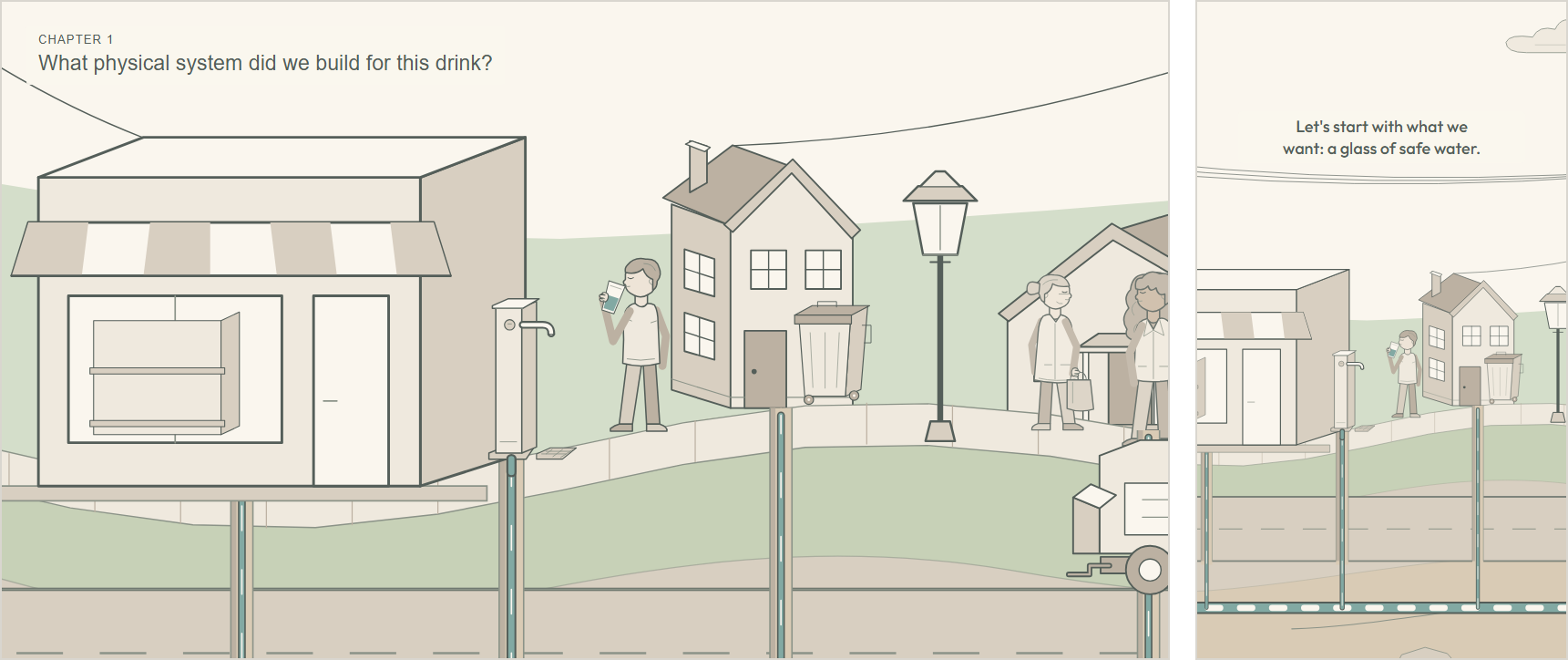
The same moment in the film (left) and in the first Short (right).
What is not done
- It has been built once, for our own channel. No pipeline like it has been built for a client yet.
- One film so far. The aim is one film a week. The first film also built the shared parts the next films reuse, so the second film is the real test of that pace.
- The Shorts are made but not out yet, and the other platforms (TikTok, Instagram, LinkedIn and X) follow YouTube.
- It depends on outside services. When Codex is unavailable, a film that needs new drawings waits.
- The channel started in October 2026. How many people it reaches is not known yet.
What this shows
If you know a subject well and want it explained in films, what you need is less a single video than a way of making them: a place where what you know becomes a brief, a checked script and a film, and where each new film reuses what the last one built. That is what was built here. Smallbox can build a pipeline like this around your subject, with your look and your narrator, in the formats your audience watches, from YouTube to Instagram, TikTok and LinkedIn.
If you have a subject you want explained in films, write to us.