 smallbox
For founders who outgrew no-code
Your no-code MVP works. Now it has to become a product.
Prototype, MVP, or no-code flow — the moment it becomes a product, one feature turns into a rule, an email, an admin action, data, a failure, a deployment. Each part needs somewhere to live, and the platform you built on decides most of that for you. That was the gift at the start. It becomes the ceiling once the product is real.
The shape of the moment
This page is for the specific situation where one of these is true:
- You built it on Bubble, Webflow, Glide, Softr, or Airtable-and-Zapier, it validated the idea, and now the next thing you need is the one thing the platform will not let you do.
- The per-seat or per-record pricing grows with your success, and the economics stop working at exactly the scale you were aiming for.
- You need to own your data, pass a security review, or integrate a vendor the platform does not support — and a no-code tool cannot get you there.
- A scrappy first version, hand-built in a hurry, proved the product — but it has no real accounts, no admin, and no safe way to change what already works.
In all four, what you built is not the problem. It did its job: it found the product. The problem is that the structure underneath it belongs to a tool you have outgrown, and the next contributor — the first developer you hire, or you in six months — has nowhere real to stand.
What you built is the spec, not the mistake
None of this argues the no-code build was a wrong turn, and none of it means starting over from a blank page. What you have is the most precise specification you will ever hold: every screen is a product decision you already made and already tested against real use — which is exactly what a written spec tries, and usually fails, to capture.
In a foundation build it is treated that way: the first workflow is read out of what you already have, not invented in a workshop. The screens that earned their keep survive. What gets replaced is the part that was never really yours — the platform-owned internals behind the demo, exchanged for identity, admin, email, failure visibility, and a deployment that connect as one system you own outright.
The honest cost: leaving the platform means its internals do not come with you, and the foundation does not pretend they do. It preserves the decisions your build encodes, not its plumbing.
Why bolting more onto the platform stops working
The reflex is to push the tool one step further: another plugin, another workaround, another integration glued on the side. Each one works, locally — which is what makes the reflex so durable. But a no-code platform is built to get you to a validated product fast, and it pays for that speed by owning the structure. You cannot put a business rule in one place, because the platform decides where rules live. You cannot hand a developer the keys, because there is no real codebase to hand over. Hitting the wall is not failure; it is the platform finishing the job it is good at, and beginning the job it is not.
What is decided before the build starts
The first step is deliberately small, and it is free: a scoping conversation that turns what you already built into a build plan. It answers, in writing:
- Which foundation modules the product actually needs — identity, operable admin, email, failure visibility, deployment — and which are deferred.
- The first workflow, named and bounded — read out of what you have, end to end: sign-up to action to admin to email to failure record.
- What survives — which screens and flows carry over as the spec, and which were platform scaffolding.
- Where it deploys, and who owns the hosting account, the domain, and the data — yours, from the start.
- What is explicitly out of scope, and the risks named before any code is written.
Those answers become the scope of the fixed €10,000 Prototype to Product + First Workflow package — agreed in writing before any work is billed.
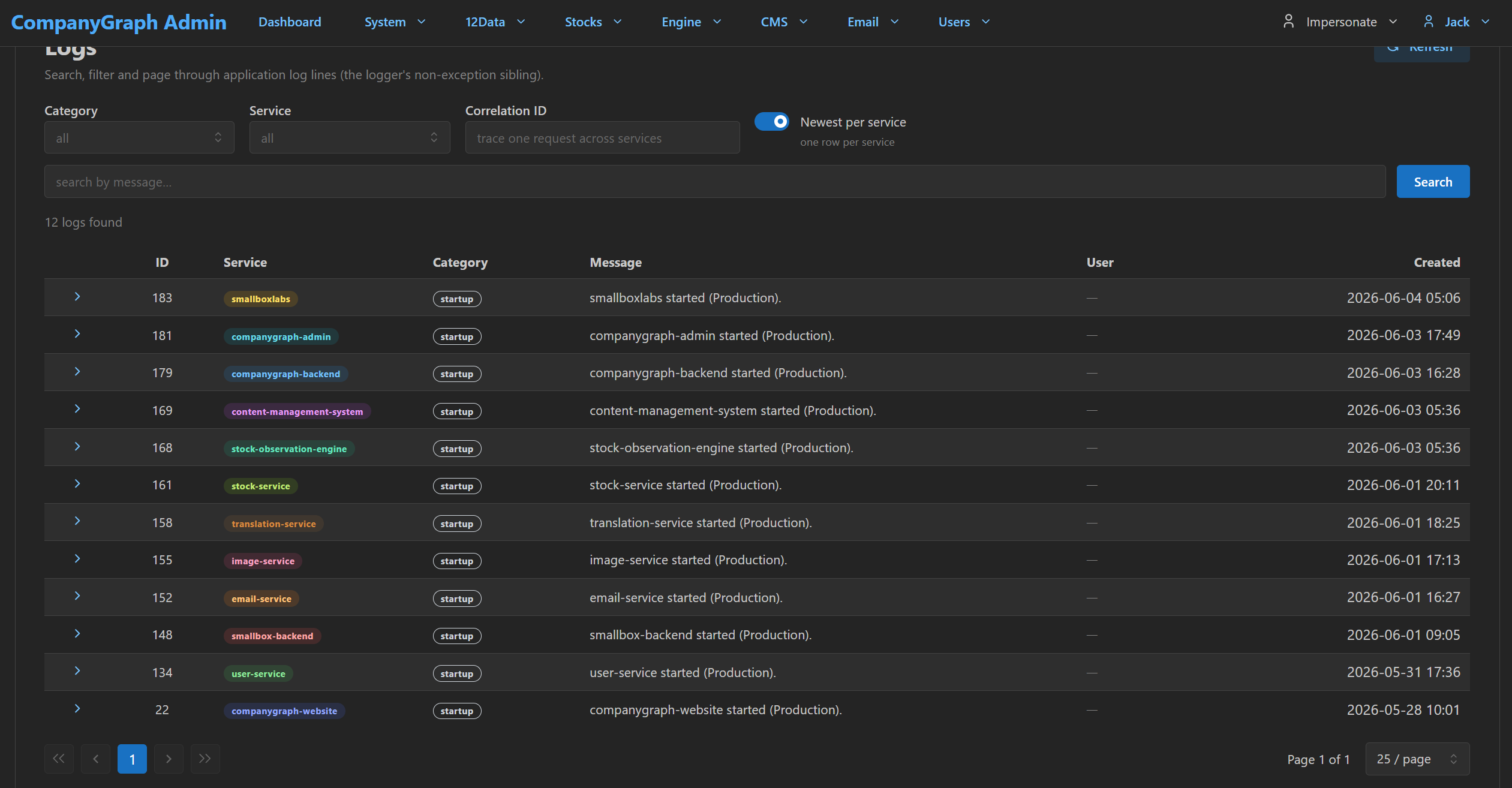
The foundation it plans for is not a diagram. It is the working shape of two live products — CompanyGraph and the site you are reading — and it reports its own existence:
When this is the wrong fit
If no-code still carries the product comfortably, stay on it — the foundation pays for itself only once you have hit the ceiling, not before. If what you built is a brochure site or an internal form, it does not need a foundation. And if it is an experiment you may abandon next month, keep prototyping; the speed of the tool is exactly right for that.
One version of this needs a different door. If a scrappy hand-built MVP has already become the production system — real users, real money, integrations accreted over months, and no one who can say what breaks when something changes — then it is no longer an MVP. It is an inherited system with stakes, and the honest first step is a read-only System Report before anything is rebuilt. A pure no-code build rarely needs one — there is no hidden code to investigate.
The full scope, what is installed, the licence, and the pricing are on the package page.